Thursday, June 20, 2024

Thames Path: Lechlade to Tadpole Bridge


Last view of Lechlade, St. Lawrence Church, as we were walking out of town.

The Thames is no ordinary waterway, it is the golden thread of our nation's history.

WINSTON CHURCHILL


We were warned by the guidebook that today's walk would be the "most remote" and in fact, the actual walk does not pass through any cities. There was a restaurant (with a Michelin bib gourmand rating--yes, of course, we strayed a half mile off the 13 mile trek to indulge) and at Radcot Bridge another small restaurant and camp store, but as far as towns go, there isn't even a town at Tadpole Bridge--just an inn: The Trout. 

More walking in head-high weeds and grass, but not the whole way

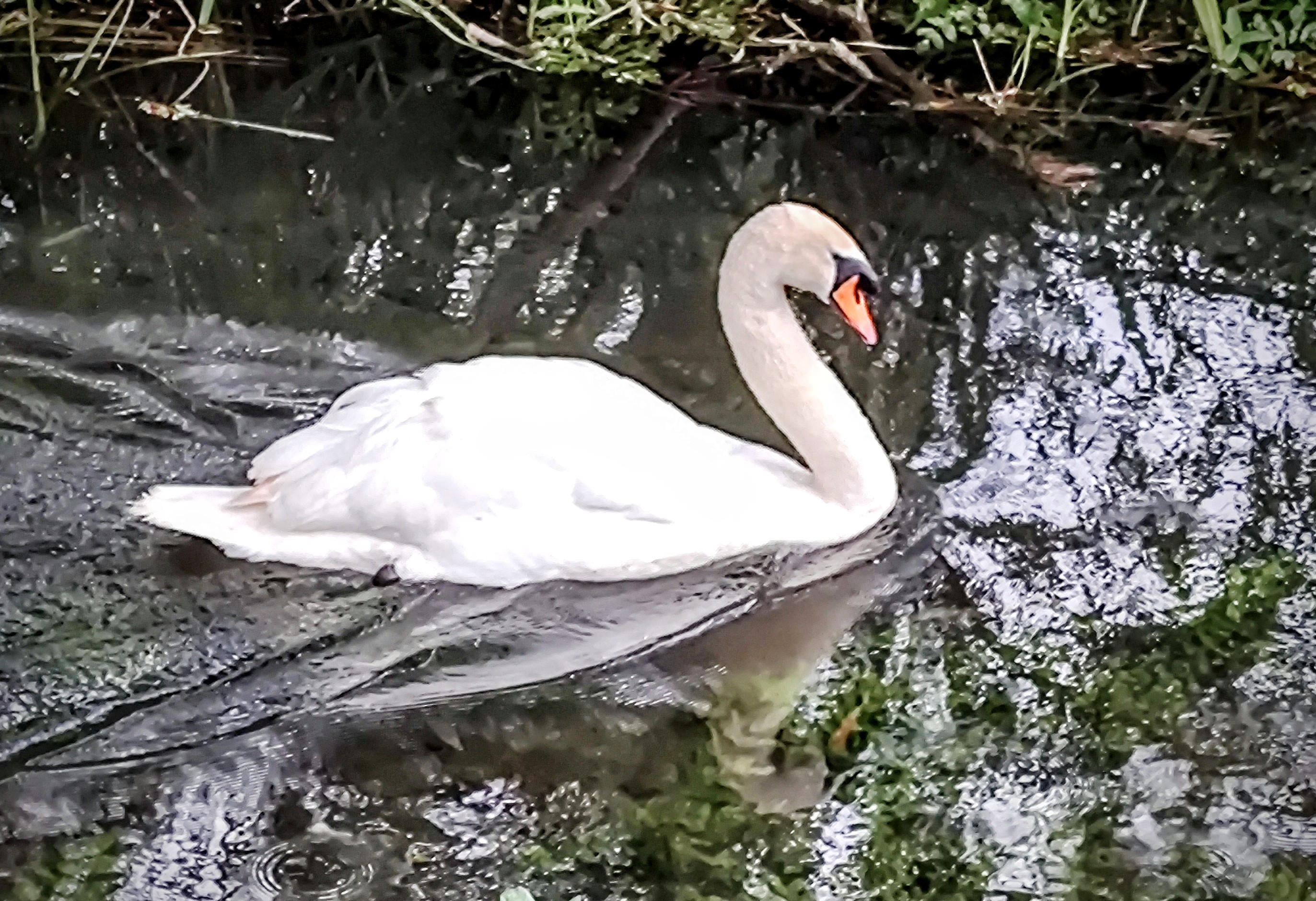
Swans and cows are constant companions: the origins of British beef

We walked along the river the entire day with all its twists and turns and were accompanied mostly by bovine and feathered friends,  but also were passed by teams of runners putting us to shame by RUNNING 185 miles  Source to Sea. We also encountered a team of men rowing a skiff for 5 days down the Thames... a bunch of friendly if a bit rowdy rugby chaps who recognized our Southern accents. Everyone here seems to know Nashville and Jack Daniels, if nothing more. 

We did get a few tastes of history as well as some hints as to what we will see now that we are on the ADOLESCENT Thames...and it keeps growing as we head toward the barrier.

World War II defensive "pill boxes" on the Thames. 

These pillboxes were part of the 'General Headquarters (GHQ) red line' designed to delay German invasion heading up from the south coast. This use of the River Thames as a natural defense line against invasion was recognized by King Alfred over a thousand years ago during the 9th century.

Not far from our origin at Lechlade, we ran into the first lock on the Thames, St. John's. The lockkeeper is responsible for the lock from 9 am to 6pm (a bit later in full summer and a bit earlier in winter), and the rest of the time, the locks are operated by the boaters themselves. We saw this boat again, The Pelican of Wargrave, tied up on the banks later on. There are 45 locks on the non-tidal River Thames. Today we passed five of them.  The biggest at Teddington holds almost 8 million litres of water – the same as 24 million cans of cola. The smallest at St John's holds almost 330 thousand litres of water – the same as 1 million cans of cola. ( I think we should just start measuring EVERYTHING in CCs=cans of cola)

At St John's lock is this 19th century sculpture, Father Thames. The statue was at one time at the head of the Thames but due to repeated vandalism out in a remote meadow, they moved it in the 1970s to this lock where it would be a bit more difficult to anonymously deface it. 

In addition to the workings of the pound locks, the lockkeepers have lovely cottages nearly always accompanied by a beautiful garden. 

Lockkeeper cottage at Radcot Lock

It seems like the less busy locks on the Upper Thames would provide an agreeable lifestyle. The busier ones downriver could get stressful at times.

Ah, yes. I guess the lockkeeper needs to ward off fools. 

The River Thames quickly transformed over just a couple of days from shallow stream to a working almost mature river but I still found it slightly astonishing that Lechlade used to be a busy port for London. Various goods- over 3000 tons of cheese annually, salt from Cheshire and golden  Taynton stone for buildings such as St. Paul’s Cathedral and Windsor Castle, were landed at the upper Thames wharves. All that trade is long gone, at least by river. The water table has dropped considerably over the years but quite a few narrow boats and smaller cruisers are not only making it this far, but were also at residential moorings.

There are many bridges of all ilks over the Thames. This one is a wooden arch, but there are ones made of stone, metal and combinations. 

Radcot Bridge has a strong claim to be the oldest extant bridge on the Thames River, being built in the early 1200 from Cotswold stone. 


 For anyone walking the path that is something of a history buff, William Morris, 19th century designer (and author, poet and other Renaissance-type behaviors)  who heavily influenced the Victorian style and whose designs are still used today had a house in Kelmscott, which you will pass within about a quarter mile on this journey.  You may wish to stop and take a look at Kelmscott Manor, as it is known today and learn more about Mr. Morris. 

Sadly, we only peeked through the gates at William Morris's little "cottage."

In addition to design, liberal politics and poetry, Morris is known for poetry and "inventing" fantasy writing. 

And don't miss this either. THE PLOUGH INN. Whether you plough into it or just walk, definitely take the short detour to eat here. We enjoyed lunch on the lawn. 

The served us Chateau de tap! On a sunny day, it tasted great!

After about 6 hours of intermittent walking and viewing sites of the Thames, we dragged our carcasses into the Trout Inn at Tadpole Bridge and rewarded ourselves with the local suds. 
Overall, another great day of discovery.


“Have nothing in your house that you do not know to be useful, or believe to be beautiful.”
― William Morris


Paul's Ponderings:   We had another 11 mile walk today in warm weather -- started out in short sleeves right away.    It's not blazing hot, but pretty warm.   Anyone doing this walk in wet weather would be pretty soaked from just the tall grass.    But, it's quite rural out here and pretty quiet.   We had a great lunch in a garden at the Plough Inn in Kelmscott and then onto our night's lodgings at the Trout at Tadpole Bridge.....more good food and ale.   They were having a comedy show outside during our dinner.   The Thames is so close here that we were able to sit on the bank and watch some canal boats dock up to the bank.    All in all a lovely day, but tomorrow it is 13 miles over to Eynsham.....a long day ahead.  

Wednesday, June 19, 2024

The Thames Path: Cricklade to Lechlade


A look back at Cricklade, the first town we stayed in on the Thames Path

Compared with other major rivers of the world, the Thames is very small. It has a total length of just 213 miles (344 kilometers). In contrast, the Mississippi River is 2,347 miles (3,780 kilometers) long and the Nile river, the world's longest river, is 4,130 miles (6,650 kilometers) long. Being such a short river, the Thames does not have as many features as bigger rivers have. It is slow and meandering for most of its length. At certain points, the river's meanders are so exaggerated that it nearly turns back on itself.

ROB BOWDEN


Today we left the White Hart Inn with 11 miles of trail ahead. And what would it bring us? Scenery? Wildlife? Lots of people? We were headed out to the next substantial town on the Thames, Lechlade. In fact, Lechlade is significantly more substantial than Cricklade and seemed to be a bit more diverse as well probably due to this being the first city on which the Thames become navigable. But enough about cities. What lies between?

Bridges of all sorts cross the Thames, particularly in this section where they don't need to be very long to cover the span. We like to call this part of the Thames the Toddler Thames instead of the Baby Thames.

A beautiful day for a long river walk. 

Swans and ducks abound on the river. 

The Virgin Mary church  in Castle Eaton where we stopped for a break has been on this site since the 12th century. It's still a working congregation and amazingly well-preserved. 

The sanctuary is still intact after 900+ years!!

Not sure when the stained glass was installed but the St.Anne is keeping a lookout. 

I'm not sure what this plaque is commemorating exactly, but apparently something Guinness book worthy took place in  1063

This part of the walk was definitely an experience of the English countryside. We did see a few other walkers, but mostly we saw grass, corn, and cows. Much of the path (which could benefit from some trail maintenance) was a simple track one person wide through pastures and farms headed toward Lechlade. At times the grass was chest-high and occasionally over-our-head high. If you want to know what England is like sans big cities, come here.

As if seeing a nearly 1000 year old church wasn't good enough, Inglesham has St. John the Baptist Church built in the 13th century. The structure isn't in as good of shape as the church in Castle Eaton, but we stopped in the graveyard and looked at the washed out headstones. There are still people being buried in the cemetery. 

St John the Baptist cemetery headstone. 

These were the first boats we saw on the Thames. I think we can now refer to it as Adolescent Thames.

11 miles later. Bitters for the non-bitter hikers.

Overall, this was not a day I would recommend to a serious hiker looking for adventure unless dodging cow patties is how they get their thrills. However, I think I understand what most of England looks like.

The Swan Inn, Lechlade. Our resting place for the night. 


Never did sun more beautifully steep
In his first splendour, valley, rock, or hill;
Ne'er saw I, never felt, a calm so deep!
The river glideth at his own sweet will:
Dear God! the very houses seem asleep;
And all that. mighty heart is lying still!

WILLIAM WORDSWORTH


Paul's Ponderings:  A great day out walking....started cool and warmed up.   We ended up with about 12 miles for the day.    There was nowhere to stop and eat other than what we took with us today, given that the Red Lion in Castle Eaton was closed today for lunch.   Mostly it was a day walking along the river and in high grass.  Some of it was "really high grass" as in chest high and with briars and nettles, but we worked it out OK.   Apparently a week ago it was quite wet and this would have been pretty miserable in that situation.    We had a nice dinner in Lechlade tonight and as usual when doing long distance walking, we were pretty worn out after that.    The summary is this part of the path is really rural and mostly fields with cows and alternating between high grass and riverside.   Some of it is well maintained but other parts are a bit of a slog due to the overgrown (but visible) path.   Take water and food if you hike this section.

Tuesday, June 18, 2024

The Thames Path; Source to Cricklade

The Source of the Thames to Cricklade Map
 

      "You absorb about 2000 years of history just by being near the Thames."  Martin Freeman


     So after talking about it for a few years, Paul and I decided to actually DO it...Walk the Thames path from the Cotswolds to the Barrier.  

     Getting to the UK and even to Swindon, a nearby train station  is pretty easy. We chose to stay in Cricklade, the first day's stop and the second day's launching point, uthat ended up being not the best idea as there is no train, cabs or bus service is very sporadic. We recommend going all the way to Kemble on the train and doing yourself the favor of being near the source instead of finding your way there...unless you want to do a 24 mile round trip.  That said, we made it!

     If you are crafty enough to manage a cab, go to the Thames Head Inn. They are close to the source and have so many people ask, they even have a diagrammed poster of how to find the path to the source blazoned across the entrance. 

A good starting point!

     From whatever starting point you choose, it is either a 0.1mile walk down a busy road with no sidewalk taking your life in your hands, or a nice 1.5 mile hike from the train station in Kemble. (We like to live dangerously, so we took the short cut.)

     The nice thing is that you are walking across a meadow full of wildflowers until you reach an "ancient ash tree" (gotta love those UK directions) and TADA! There is an engraved stone that states (perhaps falsely, BTW) that this is the source of the Thames... 150 feet below you in the ground where you can neither see nor hear it.  But that's okay, because you get your selfie here and soldier forward. 


Our walk across a field of daisies and other flowers known as Tewkesbury Meadow  to the ancient ash tree marking the source of the Thames.

The scenery in this section is pastoral

Obligatory selfie. Don't worry if you can't read the stone. Neither could we. 

From here, it about a mile or so before you see the first sign of waters from the Baby Thames, as we called it. 
Lyd Well. The first evidence that, Yes ,Virginia,  there really is a Thames River. 

There is actually quite a lot of controversy regarding where the Thames actually starts and what streams or areas are the source. To me, it's wherever the water comes up, but I am not a limnologist. (I did study it one semester in college though .)

We were often in the presence of "wild things" 

And domesticated ones. Many of the sheep in this flock had been recently shorn. Lambs were plentiful and playful. 

Swans and cygnets. 

As we approached Ashton Keynes and a few other spots, we were walking in a tunnel of trees.

We walked across fields and farms and the first 8 miles, we were never in a town. We skirted a few settlements such as Kemble, Ewen and Somerford Keynes, but didn't really see a town until Ashton Keynes. The only pub/restaurant there closes for lunch at 2pm (and isn't open Sunday or Monday), so be warned if you take a hankering to follow in our footsteps.  The town market is open however and has enough to make a lunch. 

The White Hart Inn, Ashton Keynes. Lunch til 2pm. Beer till 3pm. 


All that said, it is a pleasure to walk on the "Baby Thames" which starts so inauspiciously and ends as a mighty river.
The Baby Thames reflecting cloudy skies

The path is marked with these signs. 

Just before Ashton Keynes and almost to our final destination of today, Cricklade, is the Cotswold's Water Park, the United Kingdom's largest marl lake system, straddling the Wiltshire–Gloucestershire border, north-west of Cricklade and south of Cirencester. There are 180 lakes, spread over 42 square miles.

One of many lakes we past on the way to Cricklade

More four-legged friends along the way. You literally walk right past these guys as farmers have given easement for the Thames Path. 

In case you ever wondered if Paul is outstanding in his field (of wildflowers)

Numerous wildflowers, most of which I cannot name. 

Shetland ponies

This was from a garden. The UK folks sure do have nice ones. 

If your leg and feet hold up, about 12.5 miles later, you reach the berg of Cricklade. 

Cricklade, proud of its Anglo-Saxon heritage, once housed a royal mint in the 9th to 11th centuries. Today it appears to be a sleepy hamlet of about 4000 souls, mostly pensioners. The high street contains several restaurants, a few service related businesses, banks , a petrol station and a TESCO express. 

A well deserved bitter at the bitter end of the walk

We are staying at the White Hart Hotel--essentially a few rooms above a pub and it's quite comfy. 
Once a market house and finally a stagecoach inn, something has been on this site since the 1700s.

Overall, a good long walk amongst fields and streams and a good start to journeying with the Thames.


"Because of the Thames I have always loved inland waterways - water in general, water sounds - there's music in water. Brooks babbling, fountains splashing. Weirs, waterfalls; tumbling, gushing."    Julie Andrews


Paul's Ponderings:   We are off on our way on the Thames Path.   Today was a great day for hiking, mostly overcast, slightly cool, and no rain at all.   Mostly it was a walk through fields and flat, but plenty scenic.    Lots of local wildlife including birds and sheep (OK not all that wild) and of course, the Thames suddenly starts to appear at Lyd Well and then it is seen repeatedly.   As noted, getting to/from Cricklade to where we needed to go to start the hike, where we stayed, was a bit of a challenge, but we have mastered it (never to need it again, most likely) using taxis and our feet.   Cricklade is not a bad town to stay in at all, it is just not well served by public transport.   But, we had some good food and a comfortable stay at the White Hart in Cricklade.    Now it is on to the next 173 miles or so!